(6 minute read)
Thought, Attitude and Behavior Adjustments
As you have already learned, hopefully, it is your thoughts and attitudes that cause your actions and reactions— your behavior. Cause and effect.
Thoughts are consciously “acted on” and attitudes are “automatically triggered” without a conscious thought and the behaviors caused by each can be changed on-demand— either from the inside-in or the outside-out.
In order to change bad behavior, you must first realize that you have bad behavior that needs to be changed, and then make a conscious decision to change it.
Nobody can change it for you and it certainly will not change itself.
You can change your thinking to change your behavior, but the quick fix is to change your behavior to change your thinking.
“It is easier to act your way into right thinking than to think your way into right acting.” – E. Stanley Jones, The Choice Before Us (1937)
Change what you’re saying, how you’re saying it and what you’re doing and your thinking changes as well. The mindset and behavior must always be in harmony.
The Attitude Meter
There must be an ongoing awareness where you are evaluating your thoughts, attitudes and actions in real time, and the direction they are taking you— what you’re thinking, what you’re saying, how you’re saying it, what you’re doing, and whether those things are good or bad.
Monitor your internal Attitude Meter to make you aware the very moment your behavior goes from good to bad and take immediate action to adjust it.
The meter does not monitor world event, just your actions and reactions to all things.
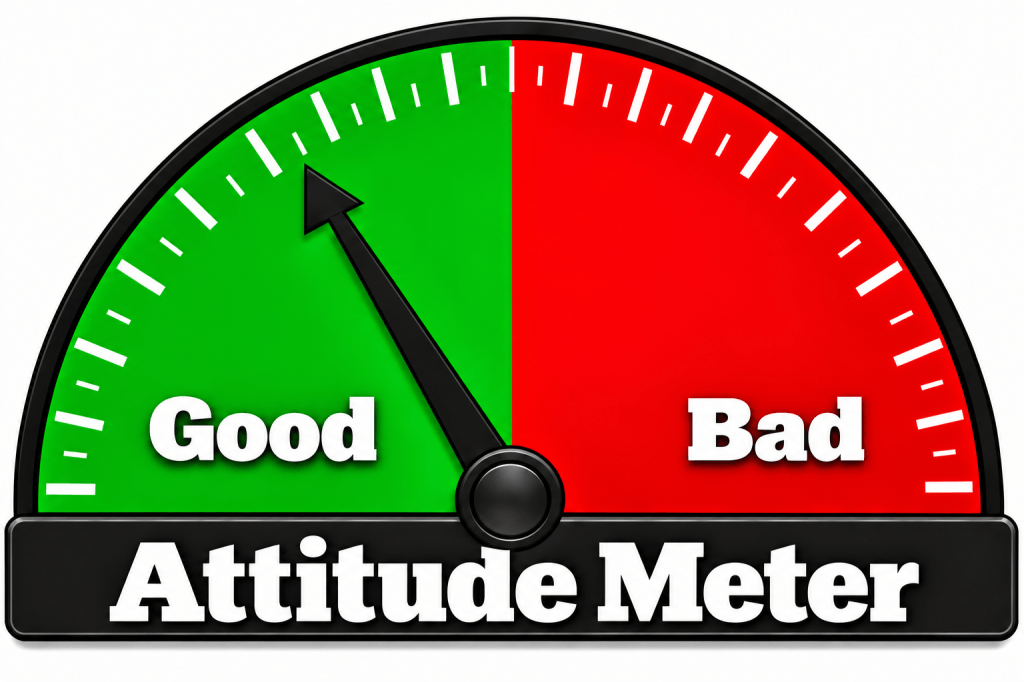
Breaking Down the Components of Your Internal Attitude Meter
There are only two options— Good (green) and Bad (red).
There is no gray area between good and bad to hide in or deceive yourself with. A gray area is where you try to convince yourself that your bad behavior is not really ‘that’ bad. It is.
Bad is ‘bad’ because it’s ‘not good.’
And if it’s not ‘bad’, then it’s ‘good’.
It’s pretty simple. It’s certainly not brain science or rocket surgery.
Good is your default factory setting, the way you have intentionally been designed to behave using God’s moral standards of right and wrong as the guide. Right and wrong equals good and bad.
There are degrees of good and bad ranging from the ‘best good’ to the ‘worst good‘ and from the ‘best bad’ to the ‘worst bad‘. But even the ‘worst good’ is still good and the ‘best bad’ is still bad. ‘Not too good‘ is still good. ‘Not so bad‘ is still bad.
The goal is to stay on good and be alerted when it ‘goes bad’.
When the imaginary needle ‘goes Bad’ (points to Bad), it calls for immediate action.
When you make an ‘attitude adjustment,’ the ‘mental meter’ automatically resets to default—goes back to good.
Reset and refocus. Next pitch.
How to Change Your Behavior Instantly
The Components: Ongoing Awareness. Catch Yourself in the Act and Do a 180. Dismiss it. Stop it. Replace it. Reset to Default.
ONGOING AWARENESS
There must be an ongoing awareness of your thoughts, attitudes and actions and which direction they are taking you.
You just gotta know when a thought, attitude or action “goes bad.” There are no alarms, bells or buzzers that go off, although a shock collar might be a good idea. Awareness, in real time, is what’s needed.
CATCH YOURSELF IN THE ACT
Catch yourself in the act of thinking thoughts you shouldn’t be thinking, saying things you shouldn’t be saying, saying things in a way you shouldn’t be saying them, and doing things you shouldn’t be doing.
Catch yourself in the act of hanging around people who are bad influences, or influencing others with your bad behavior, condoning the bad behavior of others by your presence and participation, and being in places where you have no business being.
Also be aware of the bad body language that accompanies bad behavior.
DO A 180.
Change your thinking and behavior from bad to good in an instant by turning from it and going the other way, both mentally and physically.

This is how to do a 180:
Remember Rule #1 – Everything you say and do begins with the way you choose to think.
1. DISMISS A BAD THOUGHT BEFORE YOU ACT ON IT
You can dismiss a bad thought by just thinking about something else. You can only think one thought at a time. Don’t let a bad thought lead to bad behavior.
2. STOP WHAT YOU’RE SAYING AND DOING IN ITS TRACKS
Description…..
3. REPLACE BAD BEHAVIOR WITH GOOD BEHAVIOR
Permanently replacing bad behavior with a good behavior will take some time and repetition. It has been ingrained into your heart and must be re-wired.
For example, you can go from very angry to not angry at all, in an instant by changing bad to good.
There are facial expressions and other body language that accompany every behavior— starting with the eyes, then the rest of the face and working its way down. The voice pitches up high when under distress. Good looks good. Bad looks bad. (more on body language later)
4. RESET TO DEFAULT
When you remove the bad thought, attitude and action, your automatically revert back to good behavior immediately. If it isn’t bad, it’s good.
Your behavior changes instantly.
Action words, trigger words, commands. Words and phrases.
Just like sit, heal, roll over and play dead for your dog. Commands. Although we might occasionally have to say ‘bad dog’ and get popped with the newspaper. Give yourself commands. Treat yourself like a Pavlovian dog. The work.
Just say no. No means no. Don’t say it. Don’t do it. Simple. Stop it. Reset. Fruits: Be patient, be nice, be friendly, be polite, be respectful, be fair, be quiet, be patient, give ’em some grace, change the body language, let it go,
Real life examples:
The eyes and facial expressions are the control center for the body language.
Examples: Thinking bad thoughts. Saying things, saying bad things. Doing good things. Doing bad things.
Bad does not have to be criminal or corrupt.
You don’t have to think good thoughts or even be aware of saying or doing good things. That’s the default position. It stays good until it ‘goes bad.” Evaluate and adjust.
Thinking bad things. Catch it and do a 180. Dismiss it. You automatically reset to good (default). Think something else.
Saying bad things and how to change it. Catch it and do a 180. Stop saying it. Reset. Replace bad with good if needed. Sometimes just stopping it will be enough.
Doing bad things and how to change it. Catch it and do a 180. Stop doing it. Reset. Replace bad with good if needed. Sometimes just stopping it will be enough.
When you lock in on a certain way of thinking, the behavior is to follow.
Change your thinking, change the channel.
Use trigger words and phrases- mental and verbal commands to tell your brain what to do
Other commands that work (words and phrases): Dismiss a bad thought using the power of ‘no.’ Just say ‘no’ and the thought is dismissed. Change your thinking. Think or say ‘don’t say it’ (before you say it). Or think or say ‘don’t do it’ (before you do it). If you’re already doing it, just say ‘stop.’ Just tell it to stop and it magically stops, because you told it to. Reset. Yes or no. Reset to default. Replace bad behavior with good behavior. Body language emphasis. You tell the brain what to do and it does it.
A problem is something that needs to be fixed. A solution is an action that fixes the problem.

