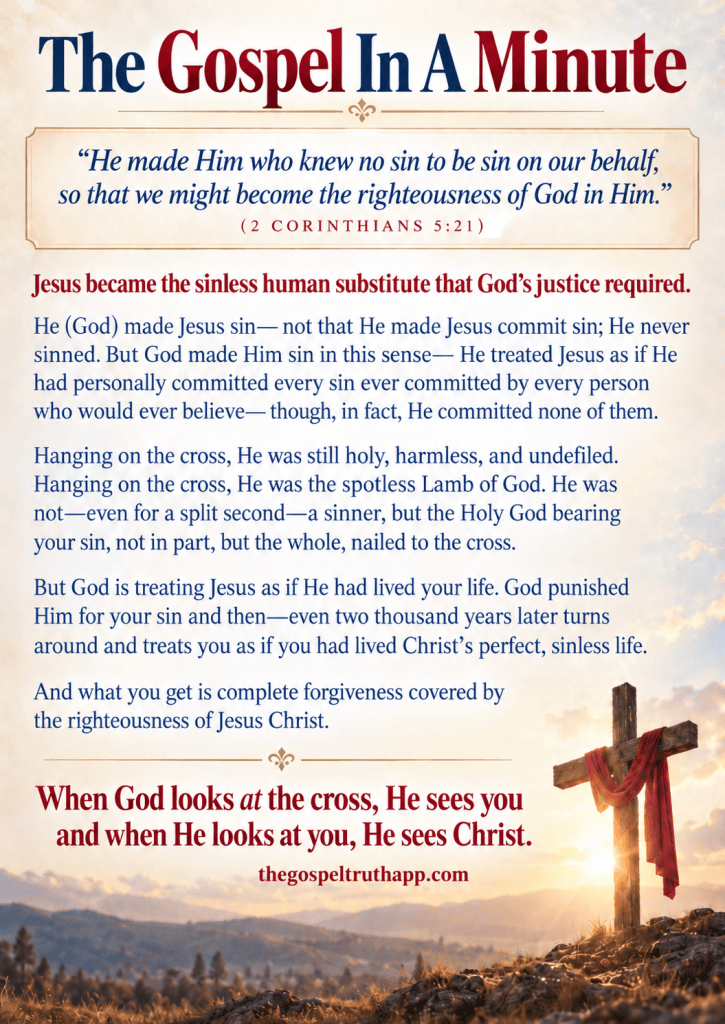

Jesus became the sinless human substitute that God’s justice required.
He (God) made Jesus sin— not that He made Jesus commit sin; He never sinned, but God made Him sin in this sense— He treated Jesus as if He had personally committed every sin ever committed by every person who would ever believe— though, in fact, He committed none of them.
Hanging on the cross, He was still holy, harmless, and undefiled. Hanging on the cross, He was the spotless Lamb of God. He was not—even for a split second—a sinner, but the Holy God bearing your sin, not in part, but the whole, nailed to the cross.
But God is treating Jesus as if He had lived your life. God punished Him for your sin and then—even two thousand years later— turns around and treats you as if you had lived Christ’s perfect, sinless life.
And what you get is complete forgiveness covered by the righteousness of Jesus Christ.
When God looks at the cross, He sees you and when He looks at you, He sees Christ.
(from 2 Corinthians 5:21)
This is one of the clearest statements of the doctrine of substitutionary atonement:
“He” = God the Father
“Him who knew no sin” = Jesus Christ, the sinless Son of God
“to be sin for us” = Christ bore the guilt and punishment of our sin on the cross
“that we might become the righteousness of God in Him.” = believers are credited with Christ’s righteousness through faith